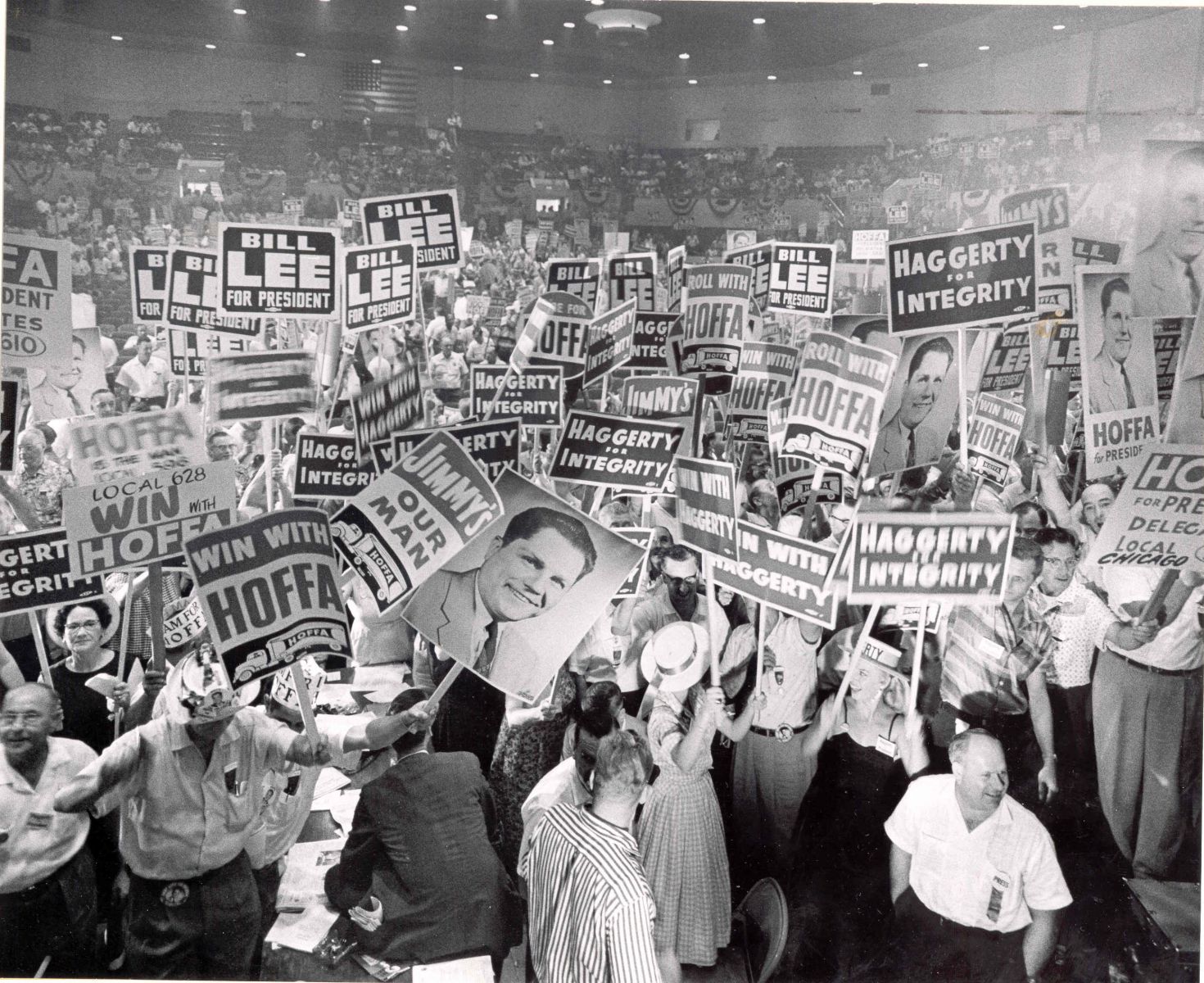
Jimmy Hoffa 1957
Texas Style
A man without a country
If you were going to suggest a cast for a reality show about life in the suburbs, you might pick Nick Ortega and his family. His house in Loveland is the stereotypic American dream: two-car garage, neatly trimmed lawn and family pictures in every corner of the living room. Downstairs, in the basement, you’ll find Ortega’s “man cave,” a couch facing a big screen TV, a foosball table and a couple of guitars from Ortega’s rock band days in the 1990s.
There are pictures of Ortega when he was a kid on a baseball team, and photos of his son’s team with Ortega standing to one side as coach.
Beyond this slice of Americana is the “living nightmare” that Ortega has yet to tell his neighbors about.
After more than four decades in Colorado, Ortega was shocked to learn that he’s not an American citizen, as his parents had always told him.
“I still wake up and can’t believe it,” he says.
He’s worked for decades in the United States without any problem. He’s filed income taxes since 1983. He has a driver’s license. He bought a house. For two decades he has lived with his common-law wife, a multigenerational U.S. citizen from Montana. Both of his children are citizens.
Ortega may have never found out he wasn’t a citizen if United Parcel Service, his employer of more than a decade, had not in 2010 run his name and the names of his coworkers through E-verify, the Department of Homeland Security’s internet-based system for determining whether employees are eligible to work in the United States. UPS told Ortega that his Social Security number identified him as someone born outside the country.
“‘That’s strange,’ I said,” says Ortega.
So began a frustrating and emotional journey where Ortega, now 47 years old, began to unravel family secrets that nobody had ever told him.
“My parents just never talked much about the past,” he says. “It was very difficult to get answers out of them.”
Eventually, he did. Ortega discovered that he was born in Mexico in November of 1966. That made him a year older than he’d always been told. He learned that he migrated from Chihuahua, Mexico to the United States with his mother and siblings in 1972 around the age of five. They traveled on a bus that was waved through a U.S. border checkpoint in El Paso. From there, the family traveled to Colorado to be with Ortega’s father, a Texas-born U.S. citizen from a family with a long tradition of farm laboring. Ortega has been in the United States ever since.
His upbringing in Greeley, Colo., was modest. His family was poor, working hard for subsistence wages. After he graduated from high school, Ortega did some construction as well as gigs with his rock band. He settled into a job at a rent-to-own store and later worked several years for a furniture sales ware house. One day, he set his sights on a job that would provide a more secure foundation for his family — driving a truck for UPS. He began as a seasonal driver, but worked constantly, punching the overtime clock every time his managers said there were extra hours to fill.
“I knew there were a lot of drivers who wanted to go full time, so I made myself stand out by working the hardest,” he says.
It paid off. He was hired as a regular driver with benefits, joined the Teamsters Union and over the years steadily inched his way up to a payday of about $90,000 a year. He shows a stack of honors he received from UPS, including nearly a decade of safe driving awards and honors for “Total Quality Service.”
When the news came that UPS was letting him go, Ortega was devastated.
“It was like my whole world was crumbling around me,” he says.
Only a handful of states require E-verify checks as mandatory for all employers. Colorado is not one of them. In Colorado, only contractors for the state and the city of Denver are required to undergo the checks that critics say may unfairly target workers and can be open to fraud. A Homeland Security Department study found that about half the undocumented workers checked by E-verify were deemed eligible for work.
The Teamsters Union Local 705 in the Chicago area chided UPS for using E-verify to check 340,000 workers around the time Ortega was let go. In the Chicago area, at least 280 employees, including possible U.S. citizens, were reportedly dismissed, according to a statement by the union.
UPS failed to return a request for comment by deadline.
New shuttle car
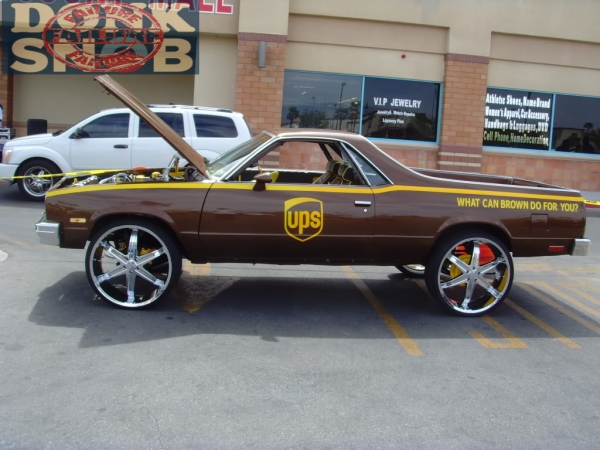
Almost looks fun
Income gap widens as American factories shut down
Income gap widens as American factories shut down
Once mighty, now a Monopoly property: How manufacturing’s decline widens the wealth gap
Associated Press
By Michael Rubinkam, Associated Press
7 hours ago
Income gap widens as American factories shut down
READING, Pa. (AP) — In August 2008, factory workers David and Barbara Ludwig treated themselves to new cars — David a Dodge pickup, Barbara a sporty Mazda 3. With David making $22 an hour and Barbara $19, they could easily afford the payments.
A month later, Baldwin Hardware, a unit of Stanley Black & Decker Corp., announced layoffs at the Reading plant where they both worked. David was unemployed for 20 months before finding a janitor job that paid $10 an hour, less than half his previous wage. Barbara hung on, but she, too, lost her shipping-dock job of 26 years as Black & Decker shifted production to Mexico. Now she cleans houses for $10 an hour while looking for something permanent.
They still have the cars. The other trappings of their middle-class lifestyle? In the rear-view mirror.
The downfall of manufacturing in the U.S. has done more than displace workers and leave communities searching for ways to rebuild devastated economies. In Reading and other American factory towns, manufacturing’s decline is a key factor in the widening income gap between the rich and everyone else, as people like the Ludwigs have been forced into far lower-paying work.
It’s not that there’s a lack of jobs, but gains often come at either the highest end of the wage spectrum — or the lowest.
“A loss of manufacturing has contributed to the decline of the middle class,” said Howard Wial, an economist with the Brookings Institution and the University of Illinois at Chicago. “People who are displaced from high-paying manufacturing jobs spend a long time unemployed, and when they take other jobs, those jobs generally pay substantially less.”
Globalization, automation and recession destroyed nearly 6 million manufacturing jobs between 2000 and 2009. In Pennsylvania, between 2001 and 2011, 258,000 middle-income factory jobs were lost. At the same time, Pennsylvania added jobs at the lower end of the wage spectrum — in health care and social services — and at the highest end, in sectors like management and finance.
Berks County, of which Reading (pronounced REH’-ding) is the county seat, is a mirror of that larger problem.
Decades ago, Reading was a mighty manufacturing town where the Reading Railroad — once the world’s largest company, now a spot on the Monopoly board — built a 19th-century transportation empire, and factories produced everything from hats to hardware. At one time, the city boasted so many manufacturing jobs that you could quit one, cross the street and easily land another, longtime residents say.
“You made a very, very good middle-class living. You could get a new car every couple years, send kids to college,” recalled Ed McCann, Berks County’s longtime director of workforce development.
Honda automotive engine plant in Anna, Ohio
An associate is seen working in the connecting rod area during a tour of the Honda automotive engine …
Then the factories shut down. The wealthy fled to the suburbs, their grand Gilded Age mansions carved up into apartments, and poor immigrants moved in. Now Reading, population 88,000, is one of the nation’s neediest cities, with more than 40 percent of its residents living in poverty, up from 19 percent in 1990.
As poverty grew, so too did the gap between the rich and everyone else. The difference between the income earned by the wealthiest 5 percent in Berks County and by a median-income household rose 13.2 percent in 20 years, according to the U.S. Census Bureau. Nationally, the wealth gap became even more pronounced, increasing 15.8 percent.
Six years after David Ludwig lost his factory job, the couple have exhausted their retirement savings. They don’t go out to eat or spend on their grandchildren.
Barbara, 56, said she has applied for more than 200 jobs since January and gotten one offer, as a shipping clerk, for $7.50 an hour. She has lost 40 pounds, blaming it on the stress.
“I don’t mind wearing the big baggy clothes, but just to put money aside to buy one or two bras because I lost too much weight, I couldn’t even do that. It sounds silly, but it’s true,” she said.
The toll can also be seen at the Greater Berks Food Bank. It distributed 7.2 million pounds last year, up from 2.5 million pounds in 2001, and the food bank plans to move into a larger building to accommodate the surging demand.
The latest wave of plant closures, beginning around the turn of the millennium, hit companies like Dana Corp., Agere Systems, Luden’s, Glidden and Baldwin Hardware. Some 9,300 jobs evaporated between 2001 and 2011 — nearly a quarter of Berks County’s manufacturing base, according to Penn State economists Theodore Alter and Theodore Fuller. They were replaced by jobs in lower-wage sectors like education and especially health care, a phenomenon that has played out around the state and nation.
“The manufacturing sector was decimated, and the people who had those skills had no place to go,” said Karen Rightmire, a longtime United Way official who now runs the Wyomissing Foundation, a private philanthropy outside Reading. “The days of the factory job that just required a strong back are gone.”
Nationally, manufacturing declines accounted for 40 percent of the increase in joblessness from 2000-2011, according to labor economist Erik Hurst. And the middle class was hit hardest.
For high-income college graduates, “It doesn’t look like there was a recession,” said Hurst, of the University of Chicago. “For lower-skilled (manufacturing) workers, the recession comes along, you get a big decline in employment, and it hasn’t rebounded at all.”
The jobs picture isn’t entirely dark. Manufacturing is still the No. 1 employer in Berks County, led by battery maker East Penn Manufacturing Co. and a specialty steel company. Economic development officials say they’ve seen a recent uptick in factory hiring, and graduates of local technical career programs are virtually guaranteed a job. Berks County has placed a huge bet on worker training, launching a “Career in 2 Years” marketing campaign that encourages people to become certified in high-skilled manufacturing fields like precision machining and robotics.
But not everyone has the aptitude or desire.
Vicki Henshaw serves on a rapid-response team that helps laid-off factory workers. She said they are typically older, with high school diplomas and outdated skills.
“You know the struggle they are going to have to even come close to the wage they were receiving,” said Henshaw, executive director of labor-affiliated United Community Services in Reading. “You look at them and you feel the despair. Their lives are now in utter turmoil.”
While the manufacturing picture has brightened a bit nationally — with the U.S. adding hundreds of thousands of jobs in recent years — it’s an open question whether the sector is truly making a comeback or the gains are merely cyclical following the recession.
Brian Waldbiesser, for one, isn’t betting on a manufacturing renaissance.
The 41-year-old father of two saw little choice but to go back to school after losing his $19.50-an-hour job at battery maker Exide Technologies, where he had put in 19 years. After a year of unemployment, he is struggling to pay the bills, and he no longer considers himself middle class.
Waldbiesser, who has tapped a federal program for workers hurt by foreign competition, is studying psychology — and psyching himself up for better times.
“I don’t want this to be a sob story about me,” he said. “What I would like for people to take from my story is that even though I am struggling, and it is radically different from where I was, if you seize the opportunities that are in front of you, there are opportunities out there to better yourself.”
Peeled like a grape

UPS in Lexington accused of racial bias in lawsuit filed by 8 past, present employees
Eight current and former United Parcel Service employees in Lexington have filed a lawsuit against UPS, alleging racial discrimination.
The employees, who are black, say in the lawsuit filed Friday in Fayette Circuit Court that they have been subjected to racist comments, disparate treatment based on race, and retaliation after they complained. The lawsuit also describes an incident in which an effigy of a black UPS driver was hung from the ceiling outside the managers’ offices for four days.
The suit names UPS and three of its managers — James Michael Mattingly, David Kleckner and Elizabeth Speaks — as defendants.
“We believe the allegations are unfounded,” UPS spokeswoman Susan Rosenberg, who works out of the company’s Atlanta headquarters, said Monday. “We take it seriously and we investigated it, and that was done when this was first called to our attention.”
The employees — William Barber, Jeffrey D. Goree, John J. Hughes, David W. Young, Curtis A. Weathers, Lamont Brown, Glenn D. Jackson and Donald L. Ragland — contend in the lawsuit that they “endured severe and pervasive comments, intimidation, ridicule and insults while working at UPS.”
Examples cited in the suit included “referencing an African-American employee as a ‘jungle bunny,’ stating to an African-American employee that his prostate cancer is a ‘black disease,’ remarks likening an African-American employee to a ‘monkey'” and other comments.
The employees say that after they went to human resources with their concerns, they were retaliated against by managers who did “extended ‘ride alongs'” with them on their delivery routes “as a subtle means to intimidate and punish the plaintiffs for raising these issues.”
They say they also were punished more severely than white employees for “alleged workplace infractions.” Two of the employees were fired; two others resigned, which the lawsuit says constitutes “constructive discharge.”
The lawsuit says that on Aug. 9, 2012, one of the managers made a dummy in a UPS uniform with a dark brown toboggan as a head and it hung from the ceiling until Aug. 13, 2012.
The dummy’s hands and one foot were tied to a ladder to demonstrate the “three points of contact” that employees should have when using a ladder. Twine was tied around the dummy’s neck and to the ceiling to “prevent the dummy from falling forward,” the lawsuit says UPS claimed.
Later, the ladder was moved and the dummy hung from the ceiling with a handwritten note that read, “no hangings please.”
Rosenberg said UPS “fundamentally disagrees with the allegations and claims that were made that a safety demonstration was held with any intent to be offensive or discriminatory. Safety is an important focus for UPS.”
She said the figure was intended to “prevent our drivers from having any injuries” by providing a visual illustration.
Luke Morgan, the attorney representing the eight men, said the effigy “had racial overtones. That clearly was understood and seen by the employees.”
“They just reached a breaking point at UPS and couldn’t take the conditions there anymore,” Morgan said. “The dummy hanging from the ceiling was just what tipped the scales to take public action.”
The employees have filed a complaint with the Equal Employment Opportunity Commission, the suit states.
Weathers, one of the plaintiffs, who has worked for UPS for nearly 37 years, said there was “a little more animosity” now than there was when he started.
“Management has some favorites, I guess,” he said Monday. “We’ve been treated a little bit different.”
For example, Weathers said, a white driver had been stopping at Jellico Mountain every day and sleeping for an hour, and no one in Lexington noticed until someone at the corporate level asked about it.
In contrast, Weathers said, he must strategize when and where to stop to take a bathroom break because management wants drivers to spend no more than six to eight minutes outside the truck to go to the restroom. Sometimes, he said, there might be a wait for a stall, or he might have to walk across a big parking lot at a truck stop. Plus, Weathers said, he has high blood pressure and diabetes, which means he needs to stop more frequently.
“It’s just little things like that that kind of irks you,” he said. “You can’t see the big gap, but you can see the little gap.”
Weathers said he was fired by UPS on May 1, after the second of two trailers he was pulling overturned as he was driving down Jellico Mountain.
Weathers said it was the first time he had driven that particular rig, a newer model with features he was not accustomed to.
“I’ve come down that mountain 27 years … I’ve never had one of the trailers do what that one did,” he said.
Weathers was reinstated later in the month, after the union became involved. He said he thought white drivers in similar situations had been brought back to work by UPS within two or three days of such an incident.
Weathers said he hoped the outcome of the lawsuit would be a workplace where employees were supervised more equally.
“I would like to see more togetherness,” he said, “to be able to sit down and talk about this, being fair.”
By Karla Ward
Seen from a new perspective