Could It Really Happen?
House Democrats call for congressional hearings on Clarence Thomas
House Democrats are intensifying their efforts to shed light on Supreme Court Justice Clarence Thomas’s ethics problems. Last week, a group of 20 Democrats demanded the Judicial Conference, the governing body for federal courts, investigate Thomas for his failure to report hundreds of thousands of dollars on financial disclosure forms. No word yet on whether the Conference will follow up, so these Democrats are also demanding Congressional hearings into Thomas. 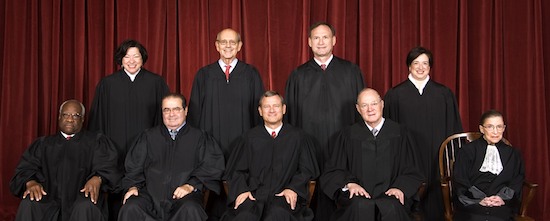
U.S. Supreme Court, Wikimedia Commons
On the steps of the Supreme Court this morning, Rep. Earl Blumenauer (D-OR), Rep. Louise Slaughter (D-NY) and others held a press conference calling on the House Judiciary Committee to hold hearings investigating some of Thomas’s alleged ethical lapses. These include allegations that he failed to disclose at least $1.6 million in income earned by his wife Virginia, who worked for the conservative Heritage Foundation and has been an active opponent of the Obama health care law. Thomas has also been accused of taking unreported free trips on a corporate jet and a yacht from real estate magnate Harlan Crow.
Blumenauer wrote to the House Judiciary committee members:
“Reports of potential ethical lapses by Justice Thomas’s actions give rise to concerns about conflicts of interest undermining appellants’ rights of due process and also raise substantive questions about Justice Thomas’s ability to retain his seat. We urge that your committee hold hearings regarding the nature of these questions, their factual basis, and their potential to undermine the public’s trust in the Supreme Court.”
In addition, Rep. Louise Slaughter, in an appearance on Countdown Tuesday night, suggested there’s a possibility of forcing a “retroactive recusal,” that could potentially also take away Thomas’s Citizen’s United vote.
SLAUGHTER: […] But what I’m very interested here, as you know, the votes that he has cast that I think may be in conflict.
And, of course his wife can work. But the fact is there are only nine Justices on that Supreme Court, and it certainly should be a given that a family member of any of those people lucky enough to be a Supreme Court Justice should not in any way involve themselves in matters that will go before that court. Now, we all know she worked very hard for the Citizens United case, which I think is one of the most egregious things that’s ever happened in the United States Supreme Court.
OLBERMANN: Agreed.
SLAUGHTER: There is such a thing as a retroactive recusal. We’re looking into that. That case, if you remember, was decided 5-4. If we could take away his vote, we could wipe that out. It would lose.[…]
You know, the judiciary is the last place for all of us to go. We are only as good, all of us, as the courts are—only as safe as the courts are good. Their interpretations are really what give us the freedoms, when you come down to it. They have enormous power. I know the attempt is always made to put the very best persons on that court. And I, as I said—again, I’m trying not to prejudge him—but you can’t say in my view that what he did was not willful, by failing to report her income. And I think there is no question about it. It is against the law. So we’re hoping that the Judiciary Commission will turn this over to the attorney general.
Common Cause has actually initiated an effort to have the Justice Department investigate whether whether Justices Antonin Scalia and Clarence Thomas should have recused themselves in Citizens United because of their participation in events sponsored by the Koch brothers.
It’s impossible that the Republican-controlled House Judiciary committee will launch an investigation and it’s also unlikely that a cautious Attorney General like Eric Holder would be willing to take on a Supreme Court Justice. So much of this effort is more intended to get at one thing: shaming Thomas into recusing himself when the Affordable Care Act comes before the Court. That also seems pretty likely, but there’s an outside chance that Justice Elena Kagan would also recuse herself, since she was acting as Solicitor General for the administration when the law was passed. Kagan’s recusal might just pave the way for Thomas’s, though it shouldn’t be unilateral.
There’s another key point here, though, and that’s to shine a light on the fact that Supreme Court justices are essentially untouchable. They are not subject to the same code of conduct that every other member of the federal judiciary must follow. Supreme Court justices, of course, are supposed to be people of such quality, of such integrity, that they would be above reproach and should not be subject to such codes. Rep. Chris Murphy has legislation that would correct that, and end the Court’s exemption from judicial ethics laws.
If China Doesn’t Like It, It Doesn’t Happen
 BEIJING (AP) — China stepped up its criticism Tuesday of a proposed U.S. law to punish countries with artificially low currencies, saying there would be serious repercussions for the world’s two biggest economies if it is passed.
The criticism comes after U.S. senators voted Monday to open a week of debate on the bill that would allow the government to impose additional duties on products from countries that subsidize exports by undervaluing their currencies.
How worried China is about the proposed law can be seen by the fact that the Foreign Ministry, the Commerce Ministry and central bank all issued statements denouncing it.
But the legislation faces considerable hurdles before it becomes law. The Obama White House, while agreeing that China’s currency, the yuan, is undervalued, has been wary of unilateral sanctions against the Beijing government.
Chinese Foreign Ministry spokesman Ma Zhaoxu said the Senate move “seriously violated WTO rules and seriously disturbed China-U.S. trade and economic relations.”
Ma said China is reforming how it manages the yuan and that since June 2010 it had increased in value by 7 percent compared to the dollar.
He repeated Chinese comments that the exchange rate is not the cause of America’s big trade deficit with China.
Ma said in a statement that China is the fastest growing export market for the United States and trade is important to both sides.
“The Chinese side appeals to the U.S. side to abandon protectionism and not to politicize trade and economic issues, so as to create a favorable environment for the development of China-U.S. economic and trade ties,” Ma said.
Supporters of the legislation say it would create new jobs and boost the U.S. economy, but China, and some in the United States, say it could trigger a damaging trade war.
The Chinese central bank warned the proposed law would not fix the economic problems in the United States and could cause more serious problems.
If the bill passes, it “cannot resolve insufficient saving, the high trade deficit and the high unemployment rate in the U.S., and it may seriously affect the progress of China’s exchange rate reform and may lead to a trade war, which we do not want to see,” the bank said.
Commerce Ministry spokesman Shen Danyang said China has taken measures to increase U.S. imports and added Beijing hopes “the U.S. side can make positive efforts in substantially relaxing restrictions on exports to China.”
WTF????
UPS to Allow Customers to Set Delivery Times
UPS hopes to eliminate the frustration of missed deliveries by adding an option for customers to specify when and where they would like their packages delivered.
The Sandy Springs logistics company called the new residential service a “seminal moment in the history of package delivery.”
“We’re making the missed delivery notice extinct, a fossil from the past,” UPS chairman and CEO Scott Davis said.
The service, called My Choice, alerts customers the day before a package is to be delivered. It gives them a four-hour expected delivery window and allows them to sign for a package electronically.
For a $5 fee, customers can re-route packages to a UPS Store or another address. A $40 premium membership allows customers to reduce the delivery window to two hours and give specific directions to a driver as to where a package can be left, including at a neighbor’s house.
The new service begins Oct. 3.
UPS, which made 90 percent of its U.S. deliveries to businesses 15 years ago, said 35 percent of its U.S. deliveries are now to homes. This is primarily due to the growth of e-commerce, which increased more than 12 percent last year. In 2010, online sales were $176.2 billion, according to the Forrester U.S. Online Retail Forecast. They are expected to be $278.9 billion by 2015.
“It’s an inflection point, it’s transformational and it’s happening now,” Davis said. “Consumers pull what they want whenever they want it.”
The move will save money for UPS by reducing the number of return trips drivers have to make, though the company did not have an estimate as to what the savings or the premium membership would do to its bottom line.
“The beauty is we go one time instead of three times,” Davis said. “We save an awful lot of miles.”
My Choice also has the potential to increase delivery volumes by encouraging people in urban areas who do not have a safe place to leave packages to shop online, UPS chief marketing officer Alan Gershenhorn said.
“This is a growth area for UPS,” he said. “We’re putting the receiver of the packages in control.”
UPS delivers to more than 100 million residential addresses each year, the company said. In a statement, QVC executive vice president of customer fulfillment services John Hunter said the feature will be appreciated by customers who want their purchases from the shop-at-home network to arrive on their schedules.
A UPS spokesman said the company had been working to allow customers to set their own delivery times for more than five years. He expected the new service to change the competitive landscape with FedEx, which does not offer a similar service.
“We’re solving a problem out there for many consumers,” Gershenhorn said.
The Atlanta Journal-Constitution
You’re Being Watched, Wherever You Go
Life at UPS is a life under constant scrutiny. Wherever you go you’re being watched. Every move you make is noted in some form or another.
The first method the company used, of course, was the stalking supervisor. The driver would be stalked, and snuck up on by the manager, or supervisor in the hopes of catching the driver cheating or stealing from the company.
Then along came the days of the DIAD implementation. At first there were no times associated with a delivery stop. Then the company re-programmed the DIAD to show a time on every “stop-complete”, whether delivery or pick-up. (“Oh no, we’re all going to be fired.”)
Next came route mapping, where the company could plot on a map the route a driver took, showing the times, and of course any discrepancies in the drivers day. Of course the company only used mapping when they thought a driver was stealing time from them. (Isn’t that every day?)
With the implementation of EDD and PAS the driver no longer made the decision as to how they were going to run the route on any given day. A comparison of what EDD said should happen, and what the driver did, could be printed out, and put before the driver with a threat of discipline if the driver did not follow EDD. (Again, all drivers are time thieves, and dishonest, and if they are not following EDD, they are thieving from the company, or so they thought.)
The latest technology for driver scrutiny, of course, is Telematics. Telematics gives management all the information possible off of GPS satellites available to the company. Start, stop, speed, location being the information most important in guessing at what the driver is doing, or not doing. Millions of dollars spent because, of course, the drivers cannot be trusted to make those decisions. (Even though the company made billions trusting them for over 100 years.)
At this point, any self respecting driver would throw up his/her arms and say, “how can I possibly function under such close watch?”
Well here’s even more discouraging news. Many business locations now have video set up to record goings on inside, and outside their businesses. Not only that, many residences also have recorders that are motion activated, and record any movements inside, and outside there homes.
One of the most common tools management has in a disciplinary hearing is the video of a particular situation in which a driver may be involved. Many times it takes much of the doubt out of what actually happened in a situation.
Click here for just such an example of what can be seen in outside video
Never assume you are “not” being watched. Whenever you are in your Brown Suit you are more noticeable and your every move is being watched by someone. Someone whom you have no control over regarding the assumptions made about what you are doing.
All of the idea of all the scrutiny is certainly overwhelming to any human, but there’s one thing to keep in mind. Finding trained people that can function under this kind of scrutiny, and remain professional, and do a professional job, are hard to find. While the company will never admit it to you, technology increases your value to the company. The days of using any “Joe Blow” as a driver are over.
The cheating, humper dumper, newspaper route type of driver is a thing of the past. Eventually the driver, not doing the job by the “methods”, will be caught. If they are not caught by the company’s technology, they’ll get caught by the customer’s technology.
That value is what will keep you with a solid career at UPS.
You just have to get used to the idea that you are being watched, every second of every day.
Fact Check On Republican Debate by AP
http://news.yahoo.com/fact-check-slippery-assertions-gop-debate-032527744.html
Here’s the reality of what they are proposing.
The ‘New Normal’ Retirement Dream Home
The Titles Need Switching

Fantastic Plastic?
There isn’t a better way to catch my attention than using a Star Trek analogy. Well, done UPS. It’s kinda like how in Star Trek III, Scotty sees a lot of unexplored potential in the ol’ Enterprise, but the brass are telling him she’s scrap because the new Excelsior’s “transwarp” engine is the only future worth having. Then we learn the Enterprise is still the only hope for their mission, while the Excelsior can’t cut it. Granted, there was some sabotage in there somewhere… but the underlying message is the same! UPS is constantly trying to counter increasing fuel prices. This is likely true with every company in transportation, but UPS recently announced and demo’d its mostly plastic delivery truck that’s 40% more fuel efficient than the current. By ditching the sheet metal for plastic, these trucks are said to be 1,000 lbs lighter. This allows for a smaller diesel engine, which lends greatly to the lower fuel consumption. But back to that Star Trek line. It seems by way of that Star Trek story that UPS doesn’t see next-gen powertrains being reliable enough for widespread use just yet. Current technology can be further advanced while the bugs are being worked out of upcoming tech. It’s not like UPS hasn’t already embraced EVs. The company blog points out that they already have 1,900 EVs delievery packages. But these are smaller vehicles whose limited range cannot match that of the classic diesel trucks. This truck is an intermediary step whose innovations seem easily carried forward to the EV age. Fast Company explains that this truck is part of the firm’s goal to increase efficiency 20% across its entire fleet by 2020 over the baseline established in 2000. The plastic brown trucks are still in the prototype stage so your UPS man will still be driving the ol’ ironside for some time.
This Plastic Delivery Truck Is The Future Of UPS