
Members were angry about concessions on health care in the national agreement but also about other issues such as the need for more full-time jobs. In 1991 the IBT constitution was overhauled to give members more democratic rights. Members won the right to vote on local supplements and riders to national contracts. Two hundred thirty-five thousand full- and part-time UPS workers vote on 28 local and regional agreements that cover issues such as the grievance machinery, working conditions, rules on seasonal workers, seniority rules, and in some cases, pensions. The constitution stipulates that the national agreement doesn’t go into effect until all supplements are ratified. Early last year, the Teamsters’ chief bargainer with UPS, Secretary-Treasurer Ken Hall, declared ending harassment the union’s main issue. But he quickly switched to a defense of health care when UPS demanded that members start paying premiums of $90 a week. Hall declared that members would not “pay nine cents” for their plans. The International sponsored a dozen local rallies against the cuts. But Hall soon accepted health care concessions anyway, for 140,000 members, including all part-timers (the insurance plans vary regionally). Members were switched from a company plan to a Taft-Hartley plan called TeamCare that had inferior coverage, higher out-of-pocket expenses, and stiffer retiree premiums. Forty-seven percent voted no on the national contract. Lots of Reasons to Vote No There were plenty of other reasons to vote no. Hall achieved only unenforceable language on limiting UPS’s intense harassment, surveillance, and overtime for drivers that averages two hours a day. A year was added to the time it takes drivers to reach top pay. So angry members organized, including on Facebook. In Philadelphia, for example, workers made “Vote No” T-shirts that they wore to work and to contract meetings. Members voted down their local riders and supplements in 18 areas, mostly in the Midwest, the West, Pennsylvania, and New Jersey, covering 63 percent of UPS Teamsters. These no votes forced the international to go back to the table and improve Teamcare benefits and lower out-of-pocket costs, not just for those in the areas that voted no but for everyone in the plan. In the wake of these improvements, the contract was approved on a second (or third) vote in most areas, after a big push by the International. But members held out in Louisville, Kentucky; Philadelphia; and western Pennsylvania. Enormous Leverage Louisville is the site of UPS’s enormous air hub, where any package that goes by air to the Midwest and South makes a stop. Nine thousand UPSers work at the hub—with, of course, a great deal of power to affect operations. But their leverage was squandered. On April 16 members of Local 89 in Louisville voted no on their supplement for the second time, this time by 94 percent. Members were angry that they spend up to an hour a day—unpaid—on a shuttle that takes them to and from the parking lot to their work stations; the site is that big. They were also demanding that more part-time jobs be converted to full-time ones. Louisville’s 94 percent no vote seemed to be the trigger that convinced the International to step in and declare both the national agreement and the three remaining local ones ratified, despite clear language in the constitution about local ratification rights. It was clear these members were not going to vote yes without some progress. But Hall insisted he knew why members had voted no on their local agreement: it was solely because of the national health care changes, which were a done deal. Because their reasons for voting no were misguided, in other words, the union needed to step in. Hall apparently relied on language that allows the national executive board to amend the ratification article of the constitution “if at any time it believes such action will be in the interests of the International Union or its subordinate bodies,” although he did not officially take such action. The constitution’s language does not mention the interests of the members—nor of UPS. UPS didn’t want to talk further about the Pennsylvania or Louisville contracts. Nor did Hall, who could have used the union’s enormous leverage—a whole national contract on hold—to force UPS to the table on members’ deeply felt local issues. Of course, this is the same Ken Hall who threw away the union’s strike threat last year. He informed UPS in the fall of 2012 that he wanted to settle the contract four months ahead of its July 31, 2013 deadline, so that customers wouldn’t have to worry about a strike. Members have used their right to vote on supplements to stop concessions in their local agreements—and to win gains. In the last bargaining round, in 2008, 7,000 UPSers in Local 804 in New York City voted no 2 to 1, held up the national agreement, and stopped the company from eliminating their 25-and-out local pension and other concessions. This round, Local 804 increased local pensions to $4,000 a month, despite pressure from the International to settle for $3,700. Politics Hall’s and President James Hoffa’s terms of office expire in 2016. It is speculated that Hoffa will retire and attempt to turn the presidency over to Hall. But the 1.2 million Teamster members have the right to vote on their national officers. In 2011, the president of Louisville’s Local 89, Fred Zuckerman, ran for international vice president on a slate that opposed Hoffa. Running separately, his slate and Teamsters for a Democratic Union’s Sandy Pope got a combined 41 percent of the vote TDU has been at the center of organizing against concessions at UPS over the last year. A conference call Saturday hosted by TDU member Mark Timlin, who runs the Vote No Facebook page, drew up to 1,000 Teamsters, mostly from UPS and freight, to hear from Zuckerman, Pope, and Local 804 president Tim Sylvester about the imposition of the contract and the future of the union. (Local 804 is also the local that recently reversed 250 firings through a concerted campaign against UPS.) Sentiment on the call was that the way to stop such contract giveaways in the future was to get rid of Hoffa, Hall, and their supporters. Callers urged the three to build a united slate. (Photo: torbakhopper)The largest private sector union contract in the U.S. had been in limbo since last summer, as UPS workers around the country voted down their local supplements, sometimes more than once. Now the five-year contract is ratified—by fiat of the Teamsters international.
UPS made $4.4 billion in profits in 2012 and another $4.4 billion in 2013.
By Jane Slaughter, Labor Notes | Report
Stop right to work
Thanks to Stop the right to work in Missouri A ‘living wage’ is offensive to American corporatocracy. 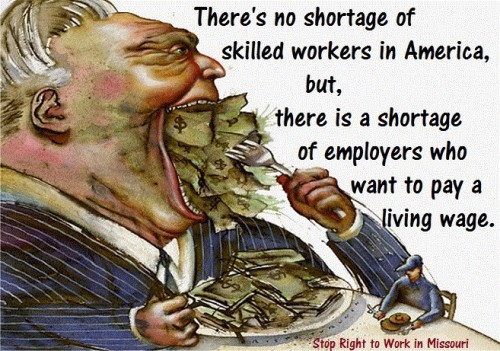
Exploitation of labor is sacrosanct to capitalism.
The New Teamster.org
Politics These Days is Nothing But Code Words

Killing Off the Traveling Public
 WASHINGTON — Drivers on the nation’s Interstates could soon be paying more to travel.
A transportation proposal sent to Congress by the Obama administration on Tuesday would remove a prohibition on tolls for existing Interstate highways, clearing the way for states to raise revenue on roads that drivers currently use at no cost. Congress banned tolls on Interstates in 1956 when it created the national highway system under President Dwight D. Eisenhower.
The administration said lifting the toll ban would help address a shortfall in funding to pay for highway repairs. The tolls, along with other changes, could provide an additional $87 billion for aging roadways, tunnels and bridges, the administration said.
The International Bridge, Tunnel and Turnpike Association, which represents toll companies and their vendors, applauded the administration’s decision.
“Tolling is a proven and effective tool to fund and finance more than 5,000 miles of roads, bridges and tunnels in 35 states,” said Patrick Jones, the group’s executive director. “To ensure our roads and bridges remain safe and reliable requires a variety of solutions. All options should be on the table so that states can choose the funding methods that work best for them.”
But the Alliance for Toll-Free Interstates, which includes American Trucking Associations, UPS, FedEx, McDonald’s and Dunkin’ Donuts, said it was disappointed.
“Tolling has proven to be an inefficient mechanism for collecting transportation revenue, consuming up to 20 percent of revenue generated, and those paying the toll may not even see that road improved because the president’s plan would allow toll revenue to go to other projects in the state,” said Miles Morin, spokesman for the alliance.
Mr. Morin said lifting the ban would cause drivers to bypass Interstate highways, hurting businesses like fast-food franchises that depend on the traffic.
Some Northeastern states, like Delaware and New Jersey, were allowed to keep tolls on existing highways that became a part of the national system. Other states were allowed to charge tolls on highways that were added to existing Interstates, but that revenue can be used only for repair and maintenance of those roads.
The proposal comes as Congress prepares to rewrite the existing surface transportation bill. A Congressional Budget Office study found that the Highway Trust Fund, which helps pays for Interstate repairs and is financed by a gasoline tax, will run out of money in August.
How to find a good restaurant

UPS | A Sci-fi VFX short film
UPS guy loses his job to a new guy. Can he get his job back?
Ain’t It the Truth

Quote from Cliven Bundy the American Patriot, (Not)
 I want to tell you one more thing I know about the Negro,” he said. “…because they were basically on government subsidy, so now what do they do?” he asked. “They abort their young children, they put their young men in jail, because they never learned how to pick cotton. And I’ve often wondered, are they better off as slaves, picking cotton and having a family life and doing things, or are they better off under government subsidy? They didn’t get no more freedom. They got less freedom.”
wtf
Hoffa-Hall Impose UPS Concessions, Steal Members Right to Vote April 23, 2014: Hoffa and Hall have implemented the UPS contract, including concessionary supplements and riders that were overwhelmingly rejected by Teamster members. According to an International Union memorandum, the UPS contract, including all supplements and riders, will go into effect on April 25 and the new Teamcare health coverage will take effect on June 1. In the memorandum, the National Negotiating Committee repeats Ken Hall’s cover story: that the only issue holding up the rejected supplements is TeamCare. This is just a lie. The Louisville Air Rider was rejected by a 94% No Vote because UPS’s second offer was even worse than its first offer and left unaddressed a whole series of pressing local issues: from members being forced to work off the clock to full-time jobs. The International Union could easily have settled the supplements by telling UPS to bargain over the outstanding local issues. Instead, Hoffa and Hall have sided with the company and forced through concessions as political payback against the leadership of Louisville Local 89 and Vote No Teamsters. Led by TDU, Teamster members fought for and won the Right to Vote on supplements and riders at the 1991 IBT Constitutional Convention to stop employers from imposing concessions in supplements and riders by pushing through a contract nationally. Click here for complete TDU coverage. Download: IBT’s Memorandum of Lies; The IBT Letter to Members; the IBT “Talking Points” for officials; The IBT Posting. Conference Call Saturday, April 26 11 am East / 10 am Central / 9 am Mtn / 8 am Pacific Teamster members have used the Right to Vote to fight concessions at UPS, YRC and UPS Freight. Now that right is under attack. Every Teamster who cares about concessions and our rights as Teamsters is invited to join this important Conference Call. Click here to register for the Conference Call this Saturday, April 26 and the call-in number and code will be sent to you. The call is being administered by the TDU office. If you are using the Firefox browser and having trouble registering, email info@tdu.org with your name, local, email and phone number and we will send you the conference call number and code. Speakers include: Mark Timlin, Founder, Vote No on UPS Contract Facebook Page Tim Sylvester, Local 804 President on how Teamster members and the community stopped UPS from firing 250 Teamsters in New York City. Fred Zuckerman, Local 89 President on the fight against concessions at UPS Worldport in Louisville. Sandy Pope, Local 805 President, on concessions and protecting our Right to Vote on Contract Supplements WHAT: Conference Call on New Concessions Threat WHEN: Saturday, April 26. 11 am East / 10 am Central / 9 am Mtn / 8 am Pacific WHO: Concerned Teamster activists, leaders of the No Concessions movement and you. Click here to register for the conference call and the call-in number and code will be sent to you. If you are using the Firefox browser and having trouble registering, email info@tdu.org with your name, local, email and phone number and we will send you the conference call number and code.
Now Hoffa and Hall have overridden members’ Right to Vote. They claim that Article 12 of the IBT Constitution gives them the right to do it. That is a another lie. Article 12 has no such language.