

Category Archives: Union
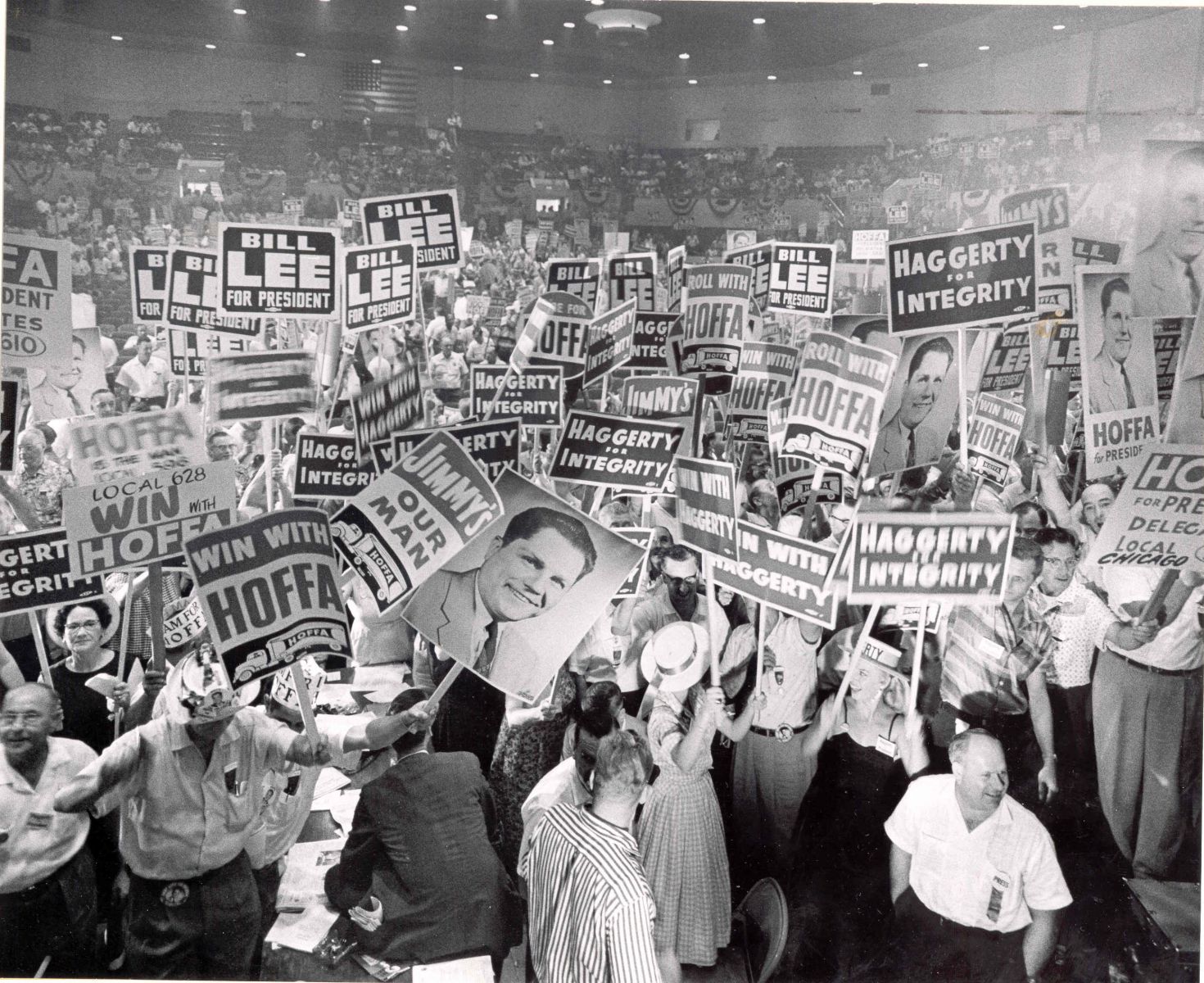
Jimmy Hoffa 1957
A man without a country
If you were going to suggest a cast for a reality show about life in the suburbs, you might pick Nick Ortega and his family. His house in Loveland is the stereotypic American dream: two-car garage, neatly trimmed lawn and family pictures in every corner of the living room. Downstairs, in the basement, you’ll find Ortega’s “man cave,” a couch facing a big screen TV, a foosball table and a couple of guitars from Ortega’s rock band days in the 1990s.
There are pictures of Ortega when he was a kid on a baseball team, and photos of his son’s team with Ortega standing to one side as coach.
Beyond this slice of Americana is the “living nightmare” that Ortega has yet to tell his neighbors about.
After more than four decades in Colorado, Ortega was shocked to learn that he’s not an American citizen, as his parents had always told him.
“I still wake up and can’t believe it,” he says.
He’s worked for decades in the United States without any problem. He’s filed income taxes since 1983. He has a driver’s license. He bought a house. For two decades he has lived with his common-law wife, a multigenerational U.S. citizen from Montana. Both of his children are citizens.
Ortega may have never found out he wasn’t a citizen if United Parcel Service, his employer of more than a decade, had not in 2010 run his name and the names of his coworkers through E-verify, the Department of Homeland Security’s internet-based system for determining whether employees are eligible to work in the United States. UPS told Ortega that his Social Security number identified him as someone born outside the country.
“‘That’s strange,’ I said,” says Ortega.
So began a frustrating and emotional journey where Ortega, now 47 years old, began to unravel family secrets that nobody had ever told him.
“My parents just never talked much about the past,” he says. “It was very difficult to get answers out of them.”
Eventually, he did. Ortega discovered that he was born in Mexico in November of 1966. That made him a year older than he’d always been told. He learned that he migrated from Chihuahua, Mexico to the United States with his mother and siblings in 1972 around the age of five. They traveled on a bus that was waved through a U.S. border checkpoint in El Paso. From there, the family traveled to Colorado to be with Ortega’s father, a Texas-born U.S. citizen from a family with a long tradition of farm laboring. Ortega has been in the United States ever since.
His upbringing in Greeley, Colo., was modest. His family was poor, working hard for subsistence wages. After he graduated from high school, Ortega did some construction as well as gigs with his rock band. He settled into a job at a rent-to-own store and later worked several years for a furniture sales ware house. One day, he set his sights on a job that would provide a more secure foundation for his family — driving a truck for UPS. He began as a seasonal driver, but worked constantly, punching the overtime clock every time his managers said there were extra hours to fill.
“I knew there were a lot of drivers who wanted to go full time, so I made myself stand out by working the hardest,” he says.
It paid off. He was hired as a regular driver with benefits, joined the Teamsters Union and over the years steadily inched his way up to a payday of about $90,000 a year. He shows a stack of honors he received from UPS, including nearly a decade of safe driving awards and honors for “Total Quality Service.”
When the news came that UPS was letting him go, Ortega was devastated.
“It was like my whole world was crumbling around me,” he says.
Only a handful of states require E-verify checks as mandatory for all employers. Colorado is not one of them. In Colorado, only contractors for the state and the city of Denver are required to undergo the checks that critics say may unfairly target workers and can be open to fraud. A Homeland Security Department study found that about half the undocumented workers checked by E-verify were deemed eligible for work.
The Teamsters Union Local 705 in the Chicago area chided UPS for using E-verify to check 340,000 workers around the time Ortega was let go. In the Chicago area, at least 280 employees, including possible U.S. citizens, were reportedly dismissed, according to a statement by the union.
UPS failed to return a request for comment by deadline.
The Package King’s faithful Teamster
May 15, 2014
In this second article in an occasional series on the history of United Parcel Service and workers’ resistance to Big Brown, explains how company founder James E. Casey brought in the Teamsters union to avoid the threat of greater labor militancy–and found the kind of labor official he wanted to work with in Dave Beck.
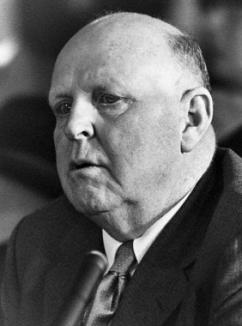 Dave Beck
“I have no use for class warfare.”
–Dave Beck, Teamster general president, 1952-57
DAVE BECK was an ambitious union politician who more than any other official in the history of the Teamsters was responsible for the union’s cozy relationship with UPS for years. Beck is a largely forgotten figure in Teamster history these days, however. If he’s remembered at all, it’s for facilitating the rise of the more ambitious and ruthless Jimmy Hoffa and his Mafia cohorts into the leadership of the union.
The first UPS drivers and package handlers were brought under a Teamster contract in the San Francisco Bay Area. Beck used his power to bring all UPSers on the West Coast into the Teamsters during that 1930s. From these small beginnings grew the enormous presence of UPSers inside the Teamsters–a literal “union within a union.”
UPS founder Jim Casey and Teamsters leader Dave Beck shared much in common. Both were born in the western United States at the end of the 19th century.
Casey hailed from the remote, windswept mining town of Candelaria, Nev. His Irish immigrant father, Henry, was a failed prospector, like many others–also like many others, he developed a debilitating lung disease from his years in the mines, that disabled him for the rest of his life. The Casey family moved to Seattle, and the dominant figure in the family was Jim’s mother Anne.
Beck was born in Stockton, Calif., in 1894 into an extremely poor family that moved to Seattle when he was four years old. Beck’s father was an unsuccessful businessman–from an early age, Dave had to work to help keep the family afloat.
For both Casey and Beck, Seattle became a launching pad for national careers–one in business and the other in the labor movement.
SEATTLE BECAME a boomtown in the late 1890s because of the Klondike Gold Rush, the last great gold rush on the North American continent. The city was the bustling way station for those heading north to the inhospitable and unforgiving environment of the Yukon province of northwestern Canada and Alaska. Eventually 100,000 prospectors made their way north, many outfitted by legitimate and illegitimate businesses serving the needs of the would-be prospectors.
Casey began his career as a messenger at the age of 11 delivering tea (and opium!) throughout Seattle; he was mentored by an elderly Irishman who taught him the delivery business. In 1907, Casey struck out on his own and founded the American Messenger Service, the foundation of UPS. The younger Dave Beck first became a Teamster in 1914, driving a laundry truck at the age of 18.
Seattle and the Pacific Northwest in the years leading up to the First World War was a bastion of U.S. radical politics and working class militancy.
In 1912, Eugene Debs, the presidential candidate of the Socialist Party, received 900,000 votes nationwide with 40,000 of them in the state of Washington. The Industrial Workers of the World (IWW), popularly known as the “Wobblies,” organized thousands of timbers workers through out the Northwest.
The decade after the end of the Klondike Gold Rush saw the economy of the region stagnate, but it began to boom again with the outbreak of war in Europe in 1914. When the U.S. entered the First World War in 1917, the economy boomed even further, resulting in skyrocketing inflation that ate away at worker’s living standards. An even bigger threat to the lives of radicals, trade unionists and “suspect” ethnic minorities was the legal assault on their constitutional freedoms by the state and federal governments and their vigilante allies.
Despite this hostile atmosphere, the union movement represented by the American Federation of Labor (AFL) grew by 400 percent from 1915 to 1918, while radical and revolutionary ideas spread through the working class. There was widespread support for the Russian Revolution of 1917 in the Pacific Northwest.
The tense political atmosphere exploded in the great Seattle General Strike of 1919, when the working class ran the city from February 6 to February 11. An elected strike committee representing the 110 local unions supporting the strike ran the city for five days. It was an incredible display of the potential of workers to run society, not just negotiate a place in it.
Striking trade unionists inspired non-union workers to join the great strike, including the messengers and deliverymen of Merchants Parcel Delivery, the second name by which UPS was known after it merged with a competing company in 1913. Many strikers and supporters were veterans of the First World War, and wore their military uniforms on the picket lines and demonstrations during the General Strike.
One notable exception was Dave Beck. He had joined the Navy soon after the U.S. entered the war in 1917 and had been stationed in England. He returned to Seattle just in time to attend a meeting of his old Teamster local union, the Laundry and Dye Works Driver Local 566, and argued not to join the general strike–it was the only Teamster local in Seattle that didn’t. Beck was proud of his scabbing on the strike, “I don’t know what I said, but I know damned well that I stood them on their feet, and how good that felt to a punk kid in a sailor outfit.”
Seattle booster and historian Nard Jones wrote, “If the general strike made a deep impression on the average citizen, it made even a deeper one on Beck.” It made Beck into a professional anti-communist and an opponent of militant trade unionism.
– – – – – – – – – – – – – – – –
ACCORDING TO Greg Niemann, the radicalism of the Seattle working class also made an impression on Jim Casey, who renamed his company United Parcel Service in the historic year of 1919. “Remember,” Niemann wrote, he was always watching. He couldn’t have helped but notice the unrest and the reasons underlying it.”
Whether Jim Casey truly understood the “unrest and the reasons underlying it” is subject to debate. Nevertheless, in 1919, faced with a well-organized union presence in the San Francisco Bay Area, Casey, according to Niemann, “invited the Teamsters to represent the several dozen United Parcel Drivers and part-time hourly package-handling employees on Oakland.”
This was a union beachhead at UPS, for the 1920s saw a tidal wave of union-busting, anti-communism and anti-immigrant hysteria that wiped away most of the gains made by the labor movement during the war years.
Some employers, however, also attempted to use modern sociology and psychology in the hopes of blunting the development of militant class-consciousness and making workers impervious to radical ideas. These were largely cosmetic changes to oppressive workplaces; internal employee corporate relations campaigns encouraged the image of a “family” atmosphere, where employees could make suggestions about better operations.
At UPS, the company newsletter The Big Idea was first published in 1924, and employee stock ownership was introduced in 1927, with these goals in mind. During the 1920s, UPS expanded up and down the West Coast from Oakland to Los Angeles, Portland, San Francisco and San Diego, and brought these policies with them.
During the same decade, Dave Beck emerged as a Teamster leader in Seattle and was poised to become the most powerful Teamster official on the West Coast. Historian David Garnel, in his book The Rise of Teamster Power in the West, described Beck’s rise during these years:
Upon his return from the war, Beck resumed laundry wagon driving and became extremely active in Local 566. He was elected to the executive of his local union and through his position regularly attended the Joint Council meetings. In 1923, Beck was elected president of Joint Council 28, an unpaid position which nevertheless offered him many opportunities to use his skills at oratory. His appetite for leadership whetted, he decided to run for secretary-treasurer of his local, and won. Early in 1925, Beck took over as principle officer of Local 566.
Dan Tobin, the conservative, if not outright reactionary, president of International Brotherhood of Teamsters (IBT), took a liking to Beck and appointed him an international organizer, which not only supplemented Beck’s income, but also widened the scope of his duties and influence on the West Coast.
Beck pursued incredibly conservative, pro-business policies that ultimately had a terrible impact on the rank and file of the union. As Dan LaBotz, author of Rank-and-File Rebellion, wrote, Beck was among the union officials who viewed “the employers as collaborators, rather than as adversaries. The union officials came to identify with the boss and his problems, rather than with the worker and his problems. Guided by this philosophy of collaboration, Beck visited all the Teamster union halls urging wage cuts in 1929 when the Crash occurred and the Great Depression began.”
– – – – – – – – – – – – – – – –
IT WASN’T until the mid-1930s that Dave Beck and Jim Casey met face to face to discuss the future of the Teamsters at UPS.
The first beachhead for the Teamsters at UPS was San Francisco, but the city was rocked by a 1934 strike on the San Francisco waterfront–which later spread to almost the entire West Coast–led by Harry Bridges, a well-known radical trade unionist from Australia who was closely allied to the Communist Party. Bridges’ union, later known as the International Longshore and Warehouse Union, not only transformed the notoriously terrible conditions of waterfront work, but threatened the position of the conservative Teamsters in the delivery and warehousing industries.
Faced with this upsurge of radical trade unionism, Jim Casey appears to have made a choice of bargaining with the Teamsters throughout most of the West Coast. But he hit a snag in Los Angeles, a violently anti-union city at the time. Dave Beck later told his biographer John McCallumin that the Teamsters were able to organize UPS from Seattle down the coast to San Francisco-Oakland. “But when it came time to go into Los Angeles,” Beck said, “we hit a brick wall. I mean, we couldn’t make a dent.”
Casey apparently feared the prospect of being ostracized by the powerful Merchants and Manufacturers Association in Los Angeles, which vigilantly policed all businesses to make sure LA remained union-free.
Beck met with Casey, and Casey refused to budge–but he threw the ball back into Beck’s court, saying, “I don’t know, you figure it out.” Beck replied, “That’s exactly what I’m going to do.” Beck says he told Casey to tell the association leaders that when UPS contracts expired throughout the West Coast, “we are either going to work for UPS in Los Angeles on the same conditions as in other cities or we are not going to work for you in any other city.”
According to Beck, the association leaders promised to underwrite UPS against any strike by the Teamsters in LA, but that Casey told the employers’ group, “If I have to fight the Teamsters in the western part of the United States, and later on maybe all over the country, I’ll have to sign with the Teamsters and take my chances with you here in LA.” Beck declared, “[F]rom that day to this, we’ve been organized with no interruptions or major labor disturbances of any significance. Soon after, we did identically the same thing with all the major companies there.”
This highly effective strategy for gaining union recognition was taken straight from the playbook of Minneapolis Teamsters, led by revolutionary socialists such the Dunne brothers, Farrell Dobbs and Carl Skoglund. Beck would later play a central role in expelling socialists from the Teamsters in the early 1940s, but he wasn’t averse to stealing their strategies while hating their politics.
Beck became more remote and conservative, as he grew more powerful. Historian Murray Morgan, in his “Skid Road: An Informal History of Seattle,” captured the changing personality and lifestyle of the once poor kid:
[Beck’s] observance of the rituals of being rich became more conspicuous. His clothes grew richer and better tailored, his office larger and more deep-toned, his cars longer, his phone conversations curter, his invitations to the annual Round Up Party at the Washington Athletic Club–a must for business and political leaders–more peremptory. It was during this period that Dave Beck moved from the modest frame house which had pinned him to the middle class, into a new Sheridan Beach estate with private pool, private cinema, even sumptuous private quarters for his private bodyguards.
Wealth and power fed arrogance and contempt toward the union members Beck claimed to represent: “Why should truck drivers and bottle washers be allowed to make decisions affecting [Teamster] policy?” he demanded to know. “No corporation would allow it.”
UPS Black Friday Surprise
May 21, 2014: UPS announced it will implement full ground and air service on the Friday after Thanksgiving even though Black Friday is a holiday under the contract.
UPS has always suspended ground deliveries on Black Friday, with Teamsters getting premium pay to do air pickups and deliveries. But this year, UPS plans to have full ground service too, according to a memo that is being read by UPS management at morning meetings called PCMs.
“We were totally, blindsided,” said Kathy Duffy, a driver from Local 384 in Willow Grove, Pa. “We’ve been fighting for more time with our families. This is the only quality family holiday that a lot of UPSers get because we’re all so exhausted at Christmas.”
UPS management says they’re implementing the change to “help clear the UPS system and prepare us for the first wave” of holiday season peak volume.
“This is a total over-reaction to what happened last year. All UPS has to do is hire more people. Instead, it’s like we’re losing a holiday,” Duffy said.
Under nearly every supplement and rider, UPS can force employees to work on a holiday if there are not enough volunteers (with the Local 804 Supplement is a notable exception).
Pay for Teamsters who work the holiday is governed by your supplement or rider. In some supplements, Teamsters who work the holiday get double-time with an eight-hour minimum, plus eight hours of holiday pay. In other supplements, it is time-and-a-half plus the holiday pay.
Ken Hall and the IBT just issued a press release bragging UPS will have to cut down excessive overtime and deal with “embarrassing staffing shortages during the last holiday season” by hiring more drivers.
Apparently UPS management has other ideas.
Another Contract Loophole Exposed
UPS made $4.5 billion in profits last year. So why will some package car drivers make less than new hires under the new contract?
Starting pay under the new contract was raised for package drivers to $18.75 an hour. But incredibly, Hall is allowing UPS to continue to pay a lower rate to more senior drivers who were making less under the old contract.
Depending on where they fall in the progression, package car drivers will make 30¢ an hour less than drivers hired a year or more after them thanks to this pro-company loophole in the new contract.
New Package Drivers get screwed under the contract too. It now takes four years to get to top pay, instead of three.
Before the contract, Hall vowed, “We’re not going to be talking about concessions, we’re going to be talking about improvements.” But actions and results speak louder than words.
The pay rate for Package Drivers who were in the progression as of last August 1 is spelled out in this chart from the IBT.
UPS Teamsters: Cash in With $50 Retro Check Discount
Retro checks are on the way May 27. Put that extra cash to work for you.
Register to attend your first TDU Convention and get a $50 discount. This limited-time offer expires on June 15. The discount is available to first-time TDU Convention attendees only.
The TDU Convention will be held November 7-9 in Cleveland.
The discounted registration rate of $175 covers most meals and all Convention workshops and materials. Hotel rooms at the Cleveland Airport Sheraton are also discounted: just $89/night for a single and $45/night for a shared room.
Click here to register and save $50 today.
Download the Docket for the UPS National Grievance Panel
The next UPS National Grievance Panel will be held June 2-5, 2014 in Boston. TDU is making the complete list of the cases to be heard at the panel available to concerned Teamsters.
Click here to download the cases before the National Grievance Committee.
Click here to download the cases before the Joint National Air Committee.
New Summary Plan Descriptions Mailed to Retirees
After being reassured that the Retirees Health plan remained unchanged, all of the retirees are being sent a new summary plan description which drastically alters coverages and costs to retirees.
Just an example of those changes is the prescription coverages. Where many of our prescriptions were covered at 100%, now we will pay 20% of the cost. Additionally, where many of us were on a 90%-10% plan, we are now being reduced to an 80%-20% plan. Another huge increase in costs.
The biggest, most devastating cost though is the inclusion of a $200 per person, $400 family deductible. Many of the current plans did not include a deductible.
These are the most glaring changes in the Summary Plan Description. The worst part is that most of the retirees I know, that retired before the contract negotiations, were led to believe that our healthcare package would remain unchanged.
The consistent story in these negotiations seems to be the Internationals secrecy in negotiating on our behalf.
Here’s another example!
Stewards Do the Math
I wrote this back when I was making $25 an hour. When you plug in your current wage rate, your argument becomes even stronger. Try it.
Have you ever gone into the office to represent a driver and had your manager whip out the calculator and start pounding in numbers. He’ll say this poor slob of a driver is not using the methods and he’s not keeping his nose to the grindstone and he’s costing the center money instead of making the center money. The manager will have a stack of reports to back up his claim: the WOR showing the driver is over allowed; Sparky, showing which stops the driver wastes time at; previous OJS rides showing demonstrated levels of performance and so on. But the ultimate hammer is the calculator. If the guy is 2 hours over and that’s at the OT rate of $38.02, then he’s literally stealing $76.04 from the company every day. That’s $380.20 per week. Or almost $2000 a year. If 50,000 drivers did this, that’s……oh my God, all the profit the company makes!! We can’t afford to have you around, you’re going to bring down the whole company! This justifies a 3 day ride and all future harassment…just look at these numbers!
But there is some math that managers never do. How about these numbers. Let’s say this poor slob of a driver comes in every day and spends just 15 minutes in his car before his start time looking for misloads and checking out his Next Day Air. That’s 15 minutes he doesn’t have on the end of his day where it would be paid at the OT rate. That’s one and a quarter hours per week at $38.02 or $47.53. Or almost $250 a year. If the guy works 25 years, he has given the company $6178 in free labor by looking over his load every morning for just 15 minutes.
Let’s say he also skips his lunch. That’s 5 hours a week at $38.02, or $190.10 a week. That’s $10,000 a year that the company gets in free labor. Let’s say 20,000 drivers are skipping their lunch everyday. That’s $200,000,000 a year in free labor that UPS is getting. Then there is the tax saving for them because they don’t have to pay Federal or State tax on that amount. The savings to UPS are huge.
But managers never do that math in the office. Stewards need to do that math and have it written in the back of their contract book so they can quote it. We can crunch numbers just as well as they can. Fight fire with fire.
Despite Local “No” Votes, Teamsters International Declares UPS Contract Ratified
Members were angry about concessions on health care in the national agreement but also about other issues such as the need for more full-time jobs. In 1991 the IBT constitution was overhauled to give members more democratic rights. Members won the right to vote on local supplements and riders to national contracts. Two hundred thirty-five thousand full- and part-time UPS workers vote on 28 local and regional agreements that cover issues such as the grievance machinery, working conditions, rules on seasonal workers, seniority rules, and in some cases, pensions. The constitution stipulates that the national agreement doesn’t go into effect until all supplements are ratified. Early last year, the Teamsters’ chief bargainer with UPS, Secretary-Treasurer Ken Hall, declared ending harassment the union’s main issue. But he quickly switched to a defense of health care when UPS demanded that members start paying premiums of $90 a week. Hall declared that members would not “pay nine cents” for their plans. The International sponsored a dozen local rallies against the cuts. But Hall soon accepted health care concessions anyway, for 140,000 members, including all part-timers (the insurance plans vary regionally). Members were switched from a company plan to a Taft-Hartley plan called TeamCare that had inferior coverage, higher out-of-pocket expenses, and stiffer retiree premiums. Forty-seven percent voted no on the national contract. Lots of Reasons to Vote No There were plenty of other reasons to vote no. Hall achieved only unenforceable language on limiting UPS’s intense harassment, surveillance, and overtime for drivers that averages two hours a day. A year was added to the time it takes drivers to reach top pay. So angry members organized, including on Facebook. In Philadelphia, for example, workers made “Vote No” T-shirts that they wore to work and to contract meetings. Members voted down their local riders and supplements in 18 areas, mostly in the Midwest, the West, Pennsylvania, and New Jersey, covering 63 percent of UPS Teamsters. These no votes forced the international to go back to the table and improve Teamcare benefits and lower out-of-pocket costs, not just for those in the areas that voted no but for everyone in the plan. In the wake of these improvements, the contract was approved on a second (or third) vote in most areas, after a big push by the International. But members held out in Louisville, Kentucky; Philadelphia; and western Pennsylvania. Enormous Leverage Louisville is the site of UPS’s enormous air hub, where any package that goes by air to the Midwest and South makes a stop. Nine thousand UPSers work at the hub—with, of course, a great deal of power to affect operations. But their leverage was squandered. On April 16 members of Local 89 in Louisville voted no on their supplement for the second time, this time by 94 percent. Members were angry that they spend up to an hour a day—unpaid—on a shuttle that takes them to and from the parking lot to their work stations; the site is that big. They were also demanding that more part-time jobs be converted to full-time ones. Louisville’s 94 percent no vote seemed to be the trigger that convinced the International to step in and declare both the national agreement and the three remaining local ones ratified, despite clear language in the constitution about local ratification rights. It was clear these members were not going to vote yes without some progress. But Hall insisted he knew why members had voted no on their local agreement: it was solely because of the national health care changes, which were a done deal. Because their reasons for voting no were misguided, in other words, the union needed to step in. Hall apparently relied on language that allows the national executive board to amend the ratification article of the constitution “if at any time it believes such action will be in the interests of the International Union or its subordinate bodies,” although he did not officially take such action. The constitution’s language does not mention the interests of the members—nor of UPS. UPS didn’t want to talk further about the Pennsylvania or Louisville contracts. Nor did Hall, who could have used the union’s enormous leverage—a whole national contract on hold—to force UPS to the table on members’ deeply felt local issues. Of course, this is the same Ken Hall who threw away the union’s strike threat last year. He informed UPS in the fall of 2012 that he wanted to settle the contract four months ahead of its July 31, 2013 deadline, so that customers wouldn’t have to worry about a strike. Members have used their right to vote on supplements to stop concessions in their local agreements—and to win gains. In the last bargaining round, in 2008, 7,000 UPSers in Local 804 in New York City voted no 2 to 1, held up the national agreement, and stopped the company from eliminating their 25-and-out local pension and other concessions. This round, Local 804 increased local pensions to $4,000 a month, despite pressure from the International to settle for $3,700. Politics Hall’s and President James Hoffa’s terms of office expire in 2016. It is speculated that Hoffa will retire and attempt to turn the presidency over to Hall. But the 1.2 million Teamster members have the right to vote on their national officers. In 2011, the president of Louisville’s Local 89, Fred Zuckerman, ran for international vice president on a slate that opposed Hoffa. Running separately, his slate and Teamsters for a Democratic Union’s Sandy Pope got a combined 41 percent of the vote TDU has been at the center of organizing against concessions at UPS over the last year. A conference call Saturday hosted by TDU member Mark Timlin, who runs the Vote No Facebook page, drew up to 1,000 Teamsters, mostly from UPS and freight, to hear from Zuckerman, Pope, and Local 804 president Tim Sylvester about the imposition of the contract and the future of the union. (Local 804 is also the local that recently reversed 250 firings through a concerted campaign against UPS.) Sentiment on the call was that the way to stop such contract giveaways in the future was to get rid of Hoffa, Hall, and their supporters. Callers urged the three to build a united slate. (Photo: torbakhopper)The largest private sector union contract in the U.S. had been in limbo since last summer, as UPS workers around the country voted down their local supplements, sometimes more than once. Now the five-year contract is ratified—by fiat of the Teamsters international.
UPS made $4.4 billion in profits in 2012 and another $4.4 billion in 2013.
By Jane Slaughter, Labor Notes | Report
The New Teamster.org
wtf
Hoffa-Hall Impose UPS Concessions, Steal Members Right to Vote April 23, 2014: Hoffa and Hall have implemented the UPS contract, including concessionary supplements and riders that were overwhelmingly rejected by Teamster members. According to an International Union memorandum, the UPS contract, including all supplements and riders, will go into effect on April 25 and the new Teamcare health coverage will take effect on June 1. In the memorandum, the National Negotiating Committee repeats Ken Hall’s cover story: that the only issue holding up the rejected supplements is TeamCare. This is just a lie. The Louisville Air Rider was rejected by a 94% No Vote because UPS’s second offer was even worse than its first offer and left unaddressed a whole series of pressing local issues: from members being forced to work off the clock to full-time jobs. The International Union could easily have settled the supplements by telling UPS to bargain over the outstanding local issues. Instead, Hoffa and Hall have sided with the company and forced through concessions as political payback against the leadership of Louisville Local 89 and Vote No Teamsters. Led by TDU, Teamster members fought for and won the Right to Vote on supplements and riders at the 1991 IBT Constitutional Convention to stop employers from imposing concessions in supplements and riders by pushing through a contract nationally. Click here for complete TDU coverage. Download: IBT’s Memorandum of Lies; The IBT Letter to Members; the IBT “Talking Points” for officials; The IBT Posting. Conference Call Saturday, April 26 11 am East / 10 am Central / 9 am Mtn / 8 am Pacific Teamster members have used the Right to Vote to fight concessions at UPS, YRC and UPS Freight. Now that right is under attack. Every Teamster who cares about concessions and our rights as Teamsters is invited to join this important Conference Call. Click here to register for the Conference Call this Saturday, April 26 and the call-in number and code will be sent to you. The call is being administered by the TDU office. If you are using the Firefox browser and having trouble registering, email info@tdu.org with your name, local, email and phone number and we will send you the conference call number and code. Speakers include: Mark Timlin, Founder, Vote No on UPS Contract Facebook Page Tim Sylvester, Local 804 President on how Teamster members and the community stopped UPS from firing 250 Teamsters in New York City. Fred Zuckerman, Local 89 President on the fight against concessions at UPS Worldport in Louisville. Sandy Pope, Local 805 President, on concessions and protecting our Right to Vote on Contract Supplements WHAT: Conference Call on New Concessions Threat WHEN: Saturday, April 26. 11 am East / 10 am Central / 9 am Mtn / 8 am Pacific WHO: Concerned Teamster activists, leaders of the No Concessions movement and you. Click here to register for the conference call and the call-in number and code will be sent to you. If you are using the Firefox browser and having trouble registering, email info@tdu.org with your name, local, email and phone number and we will send you the conference call number and code.
Now Hoffa and Hall have overridden members’ Right to Vote. They claim that Article 12 of the IBT Constitution gives them the right to do it. That is a another lie. Article 12 has no such language.