
Category Archives: Uncategorized
Compasionate Bankers Strike Again
Sure You Wouldn’t!

The American Sellout
Wednesday, July 6, 2011
Mexican trucks: Today’s attack on the middle class

The Teamsters will fight to keep the border closed to dangerous trucks, as they have for almost two decades. Teamster General President Jim Hoffa had harsh words for the agreement:
Opening the border to dangerous trucks at a time of high unemployment and rampant drug violence is a shameful abandonment of the DOT’s duty to protect American citizens from harm and to spend American tax dollars responsibly.
This so-called pilot program is a concession to multinational corporations that send jobs to Mexico. It erodes our national security. It endangers motorists. It ignores the rampant corruption among Mexican law enforcement. It lowers wages and robs jobs from hard-working American truck drivers and warehouse workers.The Owner-Operators Independent Drivers Association isn’t pleased either. Their press release said small-business truckers and drivers are fuming about the deal. Said OOIDA President Jim Johnston,
It adds insult to injury to force U.S. taxpayers to pay for monitoring equipment on Mexican trucks so Mexican carriers can take away their jobs. The DOT shows more loyalty to the Mexican people than it does to Americans.
If the agreement is good for the U.S. why the hell is he (Secretary LaHood) sneaking down there to sign it?” … Why not let the public see the details before signing the agreement? Seems like the Administration is dead set on caving to Mexico’s shakedown regardless of the costs to the American public and our tax coffers.And Rep. Peter DeFazio, an Oregon Democrat, filed a bill today to limit the pilot program and forbid the U.S. government from spending taxpayer money on equipment for Mexican trucks. DeFazio said,
…three issues must be addressed in the cross-border trucking program: safety, security and job loss. I have sent several letters to DOT asking them to address these issues. My calls for caution have gone unanswered. My legislation puts the brakes on a bad deal for American truck drivers and the traveling public…As we debate deep and harsh cuts to programs that help middle class families, it is outrageous that taxpayers are being told to foot the bill for the Mexican trucking industry to comply with American safety standards…


Prepare For the Attack
Do You Feel Better With Telematics in Place?
How Many Days Like This?
Our Politicians “Cheaper is Better No Matter What!”
 DAVID BARBOZA, On Sunday June 26, 2011, 1:26 am EDT
 SHANGHAI —
Talk about outsourcing.
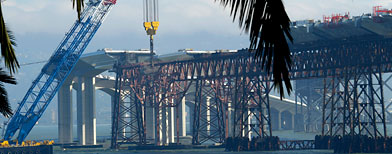
At a sprawling manufacturing complex here, hundreds of Chinese laborers are now completing work on the San Francisco-Oakland Bay Bridge.
Next month, the last four of more than two dozen giant steel modules — each with a roadbed segment about half the size of a football field — will be loaded onto a huge ship and transported 6,500 miles to Oakland. There, they will be assembled to fit into the eastern span of the new Bay Bridge.
The project is part of China’s continual move up the global economic value chain — from cheap toys to Apple iPads to commercial jetliners — as it aims to become the world’s civil engineer.
The assembly work in California, and the pouring of the concrete road surface, will be done by Americans. But construction of the bridge decks and the materials that went into them are a Made in China affair. California officials say the state saved hundreds of millions of dollars by turning to China.
“They’ve produced a pretty impressive bridge for us,” Tony Anziano, a program manager at the California Department of Transportation, said a few weeks ago. He was touring the 1.2-square-mile manufacturing site that the Chinese company created to do the bridge work. “Four years ago, there were just steel plates here and lots of orange groves.”
On the reputation of showcase projects like Beijing’s Olympic-size airport terminal and the mammoth hydroelectric Three Gorges Dam, Chinese companies have been hired to build copper mines in the Congo, high-speed rail lines in Brazil and huge apartment complexes in Saudi Arabia.
In New York City alone, Chinese companies have won contracts to help renovate the subway system, refurbish the Alexander Hamilton Bridge over the Harlem River and build a new Metro-North train platform near Yankee Stadium. As with the Bay Bridge, American union labor would carry out most of the work done on United States soil.
American steelworker unions have disparaged the Bay Bridge contract by accusing the state of California of sending good jobs overseas and settling for what they deride as poor-quality Chinese steel. Industry groups in the United States and other countries have raised questions about the safety and quality of Chinese workmanship on such projects. Indeed, China has had quality control problems ranging from tainted milk to poorly built schools.
But executives and officials who have awarded the various Chinese contracts say their audits have convinced them of the projects’ engineering integrity. And they note that with the full financial force of the Chinese government behind its infrastructure companies, the monumental scale of the work, and the prices bid, are hard for private industry elsewhere to beat.
The new Bay Bridge, expected to open to traffic in 2013, will replace a structure that has never been quite the same since the 1989 Bay Area earthquake. At $7.2 billion, it will be one of the most expensive structures ever built. But California officials estimate that they will save at least $400 million by having so much of the work done in China. (California issued bonds to finance the project, and will look to recoup the cost through tolls.)
California authorities say they had little choice but to rebuild major sections of the bridge, despite repairs made after the earthquake caused a section of the eastern span to collapse onto the lower deck. Seismic safety testing persuaded the state that much of the bridge needed to be overhauled and made more quake-resistant.
Eventually, the California Department of Transportation decided to revamp the western span of the bridge (which connects San Francisco to Yerba Buena Island) and replace the 2.2-mile eastern span (which links Yerba Buena to Oakland).
On the eastern span, officials decided to build a suspension bridge with a complex design. The span will have a single, 525-foot tower, anchored to bedrock and supported by a single, enormous steel-wire cable that threads through the suspension bridge.
“We wanted something strong and secure, but we also wanted something iconic,” said Bart Ney, a transportation department spokesman.
A joint venture between two American companies, American Bridge and Fluor Enterprises, won the prime contract for the project in early 2006. Their bid specified getting much of the fabricated steel from overseas, to save money.
California decided not to apply for federal funding for the project because the “Buy America” provisos would probably have required purchasing more expensive steel and fabrication from United States manufacturers.
China, the world’s biggest steel maker, was the front-runner, particularly because it has dominated bridge building for the last decade. Several years ago, Shanghai opened a 20-mile sea bridge; the country is now planning a much longer one near Hong Kong.
The selection of the state-owned Shanghai Zhenhua Heavy Industries Company was a surprise, though, because the company made port cranes and had no bridge building experience.
But California officials and executives at American Bridge said Zhenhua’s advantages included its huge steel fabrication facilities, its large low-cost work force and its solid finances. (The company even had its own port and ships.)
“I don’t think the U.S. fabrication industry could put a project like this together,” Brian A. Petersen, project director for the American Bridge/Fluor Enterprises joint venture, said in a telephone interview. “Most U.S. companies don’t have these types of warehouses, equipment or the cash flow. The Chinese load the ships, and it’s their ships that deliver to our piers.”
Despite the American union complaints, former California Gov. Arnold Schwarzenegger, a Republican, strongly backed the project and even visited Zhenhua’s plant last September, praising “the workers that are building our Bay Bridge.”
Zhenhua put 3,000 employees to work on the project: steel-cutters, welders, polishers and engineers. The company built the main bridge tower, which was shipped in mid-2009, and a total of 28 bridge decks — the massive triangular steel structures that will serve as the roadway platform.
Pan Zhongwang, a 55-year-old steel polisher, is a typical Zhenhua worker. He arrives at 7 a.m. and leaves at 11 p.m., often working seven days a week. He lives in a company dorm and earns about $12 a day.
“It used to be $9 a day, now it’s $12,” he said Wednesday morning, while polishing one of the decks for the new Bay Bridge. “Everything is getting more expensive. They should raise our pay.”
To ensure the bridge meets safety standards, 250 employees and consultants working for the state of California and American Bridge/Fluor also took up residence in Shanghai.
Asked about reports that some American labor groups had blocked bridge shipments from arriving in Oakland, Mr. Anziano dismissed those as confused.
“That was not about China,” he said. “It was a disagreement between unions about which had jurisdiction and who had the right to unload a shipment. That was resolved.”